
News
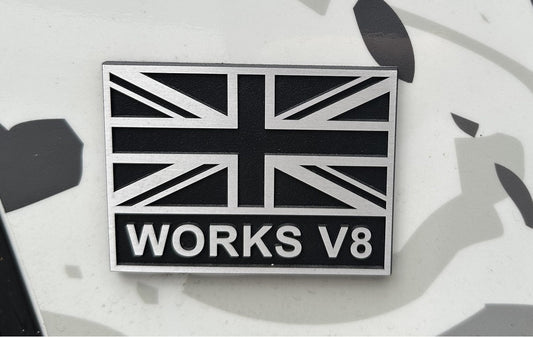
Land Rover Defender V8 Works - Investment oder Fehlinvestition?
Der Land Rover Defender wurde nach 68 Jahren Bauzeit im Jahr 2016 eingestellt.
Bereits beim Kauf unseres Land Rover Defender LXV (65th Anniversary-Edition) war bekannt, dass der Defender in den nächsten Jahren eingestellt wird und vorerst keinen Nachfolger bekommen wird.
Man hat bei unserem Verkaufsgespräch bereits davon gesprochen, dass damit zu rechnen ist, dass die Preise für gebrauchte Defender nach Produktionsende ansteigen werden. Dass sich die Preise so entwickeln würden, dass Autos mit einer KM-Laufleistung von ca. 100.000km, zum Neuwagenpreis gehandelt werden (39.000-45.000€), hatte zum damaligen Zeitpunkt niemand erwartet. Sehr gepflegte Fahrzeuge, von Sondereditionen mit Dieselmotoren, wurden nach 2016 für bis zu ca. 95.000€ angeboten.
Anlässlich des 70. Geburtstags von Land Rover, wurde eine Land Rover Defender V8 Works 70th Edition herausgebracht. Die V8 Works 70th Edition, mit erstmalig einem Leistungsstarken 5.0l-V8, 405 Benzin-PS und ZF 8-Gang-Automatikgetriebe, wurde auf 150 Fahrzeuge limitiert und hatte einen Neuwagenpreis von ca. 160.000€.
Zum Vergleich: Die bisherigen Modelle mit Dieselmotoren lagen zuletzt in der Preisrange 39.000-45.000€ (für Neuwagen), auch in Sonderausführungen mit „Edel-Interieur“.
Auch wenn ich die Idee von Land Rover, einen Leistungsstarken V8-Motor, wie bei der Mercedes G-klasse (G55 oder G63), gut fand, hielt ich den Preis zum damaligen Zeitpunkt, bereits für ambitioniert.
Man darf nicht vergessen, die Karosse, die Felgen, sowie das komplette Interieur, waren bereits 1:1 in den Dieselmodellen von 2009 bis 2016 verbaut. Man ist lediglich hingegangen und hat den Fünfliter-V8 aus dem Range Rover, allerdings ohne Kompressor, genommen und diesen mit einem ZF 8-Gang-Automatikgetriebe in den „alten“ Defender eingebaut. Bestimmt wurden dafür eine neue Spritzwand, sowie ein neuer Kardantunnel entwickelt bzw. es gab Anpassungen an den alten Ausführungen und es gab zudem andere Achsen, Differentiale und eine bessere Bremsanlage – jedoch handelt es sich bei keinem der genannten Bauteile (Motor, Achsen, Getriebe u. Bremsen) um keine Neuentwicklung.
Land Rover hatte also nichts anderes gemacht als die bekannten Land Rover Tuner, wie z.B. Overfinch usw. . Land Rover wendete das Baukastenprinzip an.
Zu der oben genannten Tatsache kam hinzu, dass es keine Neuzulassungen eines Classic Defenders geben konnte, da der Classic Defender die strengeren Crashnormen schlicht nicht mehr erfüllte. Man bediente sich an bereits zugelassenen Karossen, um hier nicht in Konflikt mit den Gesetzgerbern zu geraten.
Für mich gibt es hier keine Unterschiede zu dem, was bekannte Tuner bereits in der Vergangenheit getan haben.
Die 150 Fahrzeuge der Defender V8 Works 70th Edition waren direkt nach Verkaufsstart ausverkauft. Nach circa einem Jahr wurden erste Wagen für über 200.000€ am Markt angeboten.
Link zum Bild
Im Jahr 2021 brachte Land Rover die Works V8 Trophy Edition auf den Markt. Die Works V8 Trophy Edition war eine von 25 Fahrzeugen limitierte Sonderedition, in Anlehnung an die legendären Defender bzw. Serie III der Camel-Trophy. Der Verkaufspreis lag hier bei ca. 220.000-230.000€. Im Preis enthalten war ein exklusives 3-tägiges Kunden-Event auf dem Anwesen von Eastnor Castle in den West Midlands, wo Land Rover eine legendäre Offroad-Teststrecke betreibt.
Grober Unterschied der V8 Trophy Edition zur V8 Works 70th Edition, sind die Farben - Lackierung (Camel Trophy-Farbton) , sowie wurde das Interieur farblich angepasst, außen angebrachter Überrollkäfig mit Dachgepäckträger, Leiter am Heck, Zusatzbeleuchtungen (Schweinwerfer) über der Frontscheibe, Seilwinde, Stahlfelgen sowie die exklusive Kundenveranstaltung.
Ich stellte mir damals die Frage, ist der Mehrpreis von ca. 60.000€ für die oben genannten Unterschiede gerechtfertigt? Der Markt bejahte meine Frage ganz klar, indem auch die 25 Fahrzeuge sofort an exklusive Kunden verkauft waren.
Nachdem Eintreffen der Nachricht, dass die 25 Fahrzeuge für den o.g. Preis verkauft waren, stellte ich mir die Frage, was passiert als nächstes? Wie entwickeln sich die Preise?
Land Rover lieferte mir schnell die Antwort, indem sie 2022 den Defender Works V8 Trophy II vorstellten. Wieder eine von 25 Fahrzeugen limitierte Sonderedition zu einem Verkaufspreis ab 268.000€. Grober Unterschied von der Works V8 Trophy II zur V8 Works 70th Edition sind die Farb-Lackierung (Camouflage) sowie wurde das Interieur farblich angepasst, außen angebrachter Überrollkäfig mit Dachgepäckträger, Leiter am Heck, Zusatzbeleuchtung in Form einer LED-Lightbar über der Frontscheibe und einer Seilwinde.
Erneut stellte ich mir die Frage, ist der Mehrpreis von ca. 109.000€, im Vergleich zu einem V8 Works 70th Edition, gerechtfertigt? Wiedermals bejahte der Markt meine Frage ganz klar, indem auch die 25 Fahrzeuge sofort an exklusive Kunden verkauft waren.
Auch hier stellte ich mir als nächstes wiedermal die Frage, was passiert als nächstes? Setzt Land Rover noch einen drauf?
Land Rover bejahte zum Teil auch diese Frage, indem sie 2023 anlässlich des 75. Markengeburtstag, den Defender Works V8 Islay Edition vorstellten. Die Islay Edition ist auf 30 Fahrzeuge limitiert worden und wurde zum Verkaufspreis ab 262.000€ angeboten. Grober Unterschied zu der Works V8 Islay Edition zur V8 Works 70th Edition sind die Farben-Lackierung ( Kombi Mid Grey/ Limestone) sowie Interieur farblich angepasst und Stahlfelge. Augenmerk der Islay Edition ist das Interieur. Die Sitze, Türverkleidung, die Mittelarmlehne und die Sonnenblende sind mit Tweed- Applikation versehen. Zudem sind in jeder Cubby Box (Mittelarmlehne) Holzelemente aus Eichenholz von Whiskyfässern aus der Kilchoman Whisky-Brennerei enthalten. Die Kilchoman Whisky-Brennerei wurde 2005 von Kathy Wills und ihrem Ehemann gegründet. Kathy Wills ist die Enkelin von Spencer Wills, einem Gründer von Land Rover.
Auch die Islay Edition soll laut Medienberichten ausverkauft sein.
Wie bereits bei den drei vorherigen V8 Works Editionen, stellte ich mir erneut die Frage, was passiert als nächstes? Setzt Land Rover nochmal einen drauf? Wie entwickeln sich die Preise für die limitierten V8 Works Editionen?
Mein Bauchgefühl sagt mir, es kommt wieder was und so war es auch.
Seit 2024 besteht die Möglichkeit bei Jaguar Land Rover Classic sich einen individuellen V8 Works als 90er oder 110er zu bestellen. Unter dem folgenden Link findet ihr den Konfigurator:
Hier zum Konfigurator von Land Rover
Auch auf meine Preisfrage hin, finde ich am Markt Antworten. Jaguar Land Rover Classic in Essen-Kettwig bietet einen 70th Edition für 269.000€ an. Der Jaguar Land Rover Vertragshändel Moll GmbH & Co. KG aus Düsseldorf, bietet einen Works V8 Islay Edition für 349.950€ an.
Um meine Grundfrage aus der Headline zu beantworten, es scheint, Stand heute, ein Investment mit nennenswerter Prozentsatzverzinsung zu seien, eine limitierte Defender V8 Works Edition zu kaufen.
Ich bin sehr gespannt, wie sich der Markt in Zukunft verhält.

Land Rover Defender special series: LXV - 65th Anniversary
Defender as an investment?
I keep getting written to and asked how much my Defender LXV cost new. The conversations afterwards always go the same way: “Ohh, now a used car costs significantly more” or “The Defender prices have generally increased significantly”.
These types of conversations led me to create a blog and YouTube series about the special series of the old Defender and show that investing in an original Defender can be worthwhile.
With this special series I would like to show how the special series were delivered to the dealer, because in my opinion original cars have the best increase in value or the best return on capital.
So, and now to the special series LXV:
Under the heading “65 Years of Cult,” Land Rover launched a special series in 2013 to mark the 65th birthday of the Land Rover Defender, which has been in production since 1948 (with a few changes). The special model LXV (Roman number 65) was limited to 605 vehicles worldwide. Of the 605 limited edition vehicles, 130 were sold on the German market. The LXV special series was only available in the 90 and 110 wheelbase in two special color variants and this had a list price of €39,900.00 for the 90 wheelbase and €45,500.00 for the 110 wheelbase.
I myself have seen the following variants of the above-mentioned wheelbases on the Internet over the last 6 years on Mobile and AutoScout24: 90 wheelbase with rear side windows (both color variants) and without rear side windows (only metallic paint in Santorini Black), 110 as a station wagon both color variants and once I saw a 110 as a Crew Cab or 110 Double Cab pick up in white.
What were the prices mentioned above?
The Defender SE served as the basis with the following standard equipment:
Alarm system, perimetric, with immobilizer
Center differential lock
Mud flap, rear
side running boards
Engine: 2.2l TD4 diesel, maximum power 90 kW (122 hp) at 3,500 min and a maximum torque of 360 Nm at 2000 min
Transmission: 6-speed manual transmission with off-road reduction
In addition to the basic equipment, the Defender LXV also had the following equipment:
Inner space:
Storage box or Chubbybox with contrasting stitching in orange
LXV metal keychain with LXV embossing
Exclusive package (front electric windows and central locking)
Luggage net in the rear door
air conditioner
Leather steering wheel with orange contrast stitching
Center console painted in Corris Gray
7 seater package
Premium leather-fabric sports seats with Land Rover and LXV logo with heated seats
All 7 seats have contrasting orange stitching
Alpine radio with CD, USB, Bluetooth with hands-free system
4 speakers
Floor mats with LXV emblem
Winter comfort package, i.e. heated windshield, heated seats
Exterior equipment:
There were two color variants for the exterior paint: metallic paint in Santorini Black or plain paint Fuji White. The Fuji White comes from the Range Rover and was not otherwise available on the Defender. 16" Saw Tooth rims in Glossy Gray, with silver Land Rover emblems on the wheel hubs.
Goodyear MT/R tires
Rim lock in screw look
ABS including electronic traction control
Front grille slats painted in Santorini Black
LXV stickers on the rear and the two front doors
Wheel arch extensions painted in body color
Headlight surround and front grille surround painted in Corris Gray
Price development:
Since the number of units is limited, the price has increased significantly in recent years.
90s are traded with high km readings for €35,000.00 - €45,000.00 and with low km readings under 100,000 km for €45,000.00 to €75,000.00.
Things look a little different with the 110. Here, high km readings (i.e. from 100,000 km) are traded for €40,000 - €65,000 and low km readings under 100,000 km are trading at €50,000.00 to €85,000.00. The price development just mentioned is from the past and I estimate that prices will increase a little in the future.
The 110 Crew Cab mentioned above was offered at the time for around €60,000 and had a mileage of less than 100,000 km. Unfortunately, I have not yet been able to verify with Land Rover whether this was an original.
Spare parts supply:
In 2018 I asked my local Land Rover dealer for parts for my LXV. I wanted to reorder the floor mats and the key ring because I couldn't find mine at the time. According to the local Land Rover dealer, the parts would not be available to order. Shortly afterwards I called the Classic Center in Essen Kettwig myself. Here the parts were still normally available and you could quote spare part numbers and prices.
Floor mat set LR051769 price. approx. €250.00
Keychain LR051770 Price. approx. €234.00
But be careful!
You can only reorder the parts if you present your vehicle registration document or vehicle registration document when ordering.
I hope that with the information and pictures listed above I was able to give you a good impression of what makes an original Defender LXV - 65th Anniversary.
If I have forgotten any information, you are welcome to write to me personally so that I can add it.

Range Rover P38
My first blog post is about the Range Rover P38 on the occasion of my new acquisition.
Many are probably asking the question, why did you buy P38?
Very easy! It is the counterpart to my Jaguar X308 and something in between,
between my Jaguar and my Defender.
The Range Rover P38 was produced at the Solihull factory from 1994 to 2002.
A total of around 167,259 examples were produced. Its name "P38" or "P38A",
he got it from the office building where the development was based.
During the early stages of development the engineering team was based in the Engineering Block in Solihull,
and the vehicle was known under the project names “Pegasus” and “Discovery” and was changed to P38A,
as the team moved to Block 38A in Solihull. “Discovery” was also chosen to confuse the press
and distract.
It is estimated that between 5,000-10,000 vehicles were sold in Germany.
Unfortunately, there is no official information about this and I got this information from an unconfirmed source.
The low number of units in Germany was probably due, on the one hand, to
that the SUV boom only started around 2005 and people were probably still frightened by the result, by "British misery" :-)
About the design of the P38:
The P38 was designed by a team of designers led by Charles Spencer King.
He was also responsible for the design of the original 1970s Range Rover.
For the P38, the design of the original Range Rover was further developed and modernized,
to meet the demands of the modern market.
The result was a striking and elegant design that made the Range Rover P38 one of the iconic off-road vehicles of the 1990s.
Motorizations:
There were a total of three different engines for the Range Rover P38:
Until 1999
4.0 liter V8 petrol engine with an output of 190 hp | 320 Nm at 3000 rpm
4.6 liter V8 petrol engine with an output of 224 hp | 377 Nm at 3000 rpm
2.5 liter turbo diesel engine with a power of 136 hp (BMW M51 engine) | 270 Nm at 2300 rpm
It should also be noted that over the course of the P38's production period there were some minor changes to the engines
and whose specifications have been made.
The new Bosch Motronic engine management system from the BMW 7 Series (E38) was used for the first time. This replaced the Lucas "SAGEM" GEMS system.
This changed the power and torque of the V8 engines (4.0 and 4.6 liters).
From 1999
4.0 liter V8 petrol engine with an output of 188 hp | 340 Nm at 2600 rpm
4.6 liter V8 petrol engine with an output of 218 hp | 400 Nm at 2600 rpm
The petrol engines have a 100l tank and the diesel has a 90l tank.
Dimensions:
The dimensions for all engines are as follows:
Wheelbase: 274.0 cm
Length: 471.0 cm
Width: 189.0 cm
Height: 182.0 cm
Trunk volume: 520 L
Landing gear:
The P38's air suspension, also called EAS (Electronic Air Suspension), was one of the vehicle's strengths at the time, as it was able to
to offer a good balance between comfort and off-road capability.
The Range Rover P38 featured a fully independent chassis with independent front and rear suspension.
Four different driving modes can be selected for the road and the terrain.
There is an additional mode that is there if the body is resting or stranded off-road, for example.
Today, the air suspension is unfortunately decried because the lines, air bellows and compressors are porous or defective due to age (wear and tear).
Normal workshops find it difficult to repair them because a P38 is rather rare.
There are many good YouTube videos and instructions online.
The new price for the Range Rover P38 depended on the equipment and the engine chosen.
In 1994 the basic price for the basic model was around 69,000 DM,
which corresponds to around 35,000 euros.
In 2002, the new price for the basic model was around 75,000 euros.
The Range Rover P38 was available in three trim levels: SE, HSE and Autobiography.
The SE version was the basic variant and already offered extensive equipment.
The HSE version was even more luxuriously equipped and the Autobiography version was the top trim with even more extensive equipment.
For the SE version:
The SE version of the Range Rover P38 was the basic version and already offered extensive equipment.
Here are some details about the SE version's features:
Air suspension
Automatic level control
ABS and traction control
Electrically adjustable and heated exterior mirrors
Electrically adjustable front seats
air conditioner
CD changer
Driver and passenger airbags
The SE version could optionally be equipped with further extras,
such as an electric sunroof, leather seats and a navigation system.
Prices for the SE version depended on the engine and equipment.
The basic price in 1994 was around 69,000 DM, which corresponds to around 35,000 euros.
In 2002, the new price for the basic model was around 75,000 euros.
Unfortunately, there are no official production figures. It is assumed that at least 50% of all
Produced Range Rover P38, as SE version were produced.
I would be happy if someone could send me the official production numbers.
For the HSE version:
The HSE version of the Range Rover P38 was the higher trim level and
offered the following extras in addition to the SE equipment:
Electrically adjustable steering wheel
Memory function for driver's seat and exterior mirrors
CD changer with premium speaker system
Wood applications on the dashboard and door panels
Leather seats
Headlight cleaning system
The HSE version could optionally be equipped with further extras such as a navigation system,
an electric sunroof or a refrigerator in the trunk.
The prices for the HSE version depended on the engine and equipment.
The basic price in 1994 was around 79,000 DM, which corresponds to around 40,000 euros.
In 2002, the new price for the basic model was around 88,000 euros.
Unfortunately, the exact number of HSE models of the Range Rover P38 produced is not available.
However, it is estimated that around 30-35% of all Range Rover P38s produced were the HSE version.
About the Autobiography version:
The Autobiography version of the Range Rover P38 was the most highly equipped and exclusive variant.
Here are some details about the features of the Autobiography version:
Exclusive leather interior (individual / different leather colors)
Front seats with electrical adjustment and memory function
navigation system
Fridge in the trunk
18-inch alloy wheels
Wood applications on the dashboard and doors
Optional folding tables for the second row of seats, in the front seats
The Autobiography version could optionally be equipped with additional extras such as a TV system or a telephone system.
Prices for the Autobiography version depended on the equipment. The basic price in 1995 was around 130,000 DM,
which corresponds to around 66,000 euros.
In 2002, the new price for the basic model was around 135,000 euros.
It is the rarest variant of the Range Rover P38.
Special editions:
There were various special editions of the Range Rover P38, such as the Holland & Holland, the Linley and the Westminster.
One of the most famous special editions is the 30th Anniversary.
The Range Rover P38 30th Anniversary was a special edition,
which was introduced in 2000 to mark the 30th anniversary of the Range Rover.
Here are some details about the features of the 30th Anniversary version:
Exclusive leather interior in bi-color green/beige with Lightstone piping (piping)
Front seats with electrical adjustment and memory function
Heated seats for front and rear seats
Real wood interior trim - Burr maple wood veneer
18-inch six-spoke alloy wheels
Special paintwork in “Wimbledon Green”
30th Anniversary logos on the fenders and door sills
CD changer and radio with cassette player
In addition, the 30th Anniversary version could be equipped with extras such as a navigation system or an electric sunroof option.
The basic price for the Range Rover P38 30th Anniversary was around 95,000 DM in 2000,
which corresponds to around 48,500 euros. It is believed that 100 RHD and LHD vehicles were produced.
Special equipment:
There were a variety of special features on the above-mentioned variants,
such as electrically adjustable seats, a navigation system, automatic climate control,
an auxiliary heater, an electric sunroof, telephone and much more.
I will go into this again separately as soon as I have good price lists.
Prototypes:
Behind the scenes, attempts were made to expand the luxury segment,
in which two prototypes were built with a V12 engine from BMW (5.4 V12 M73).
However, the project was shelved and never went into production.